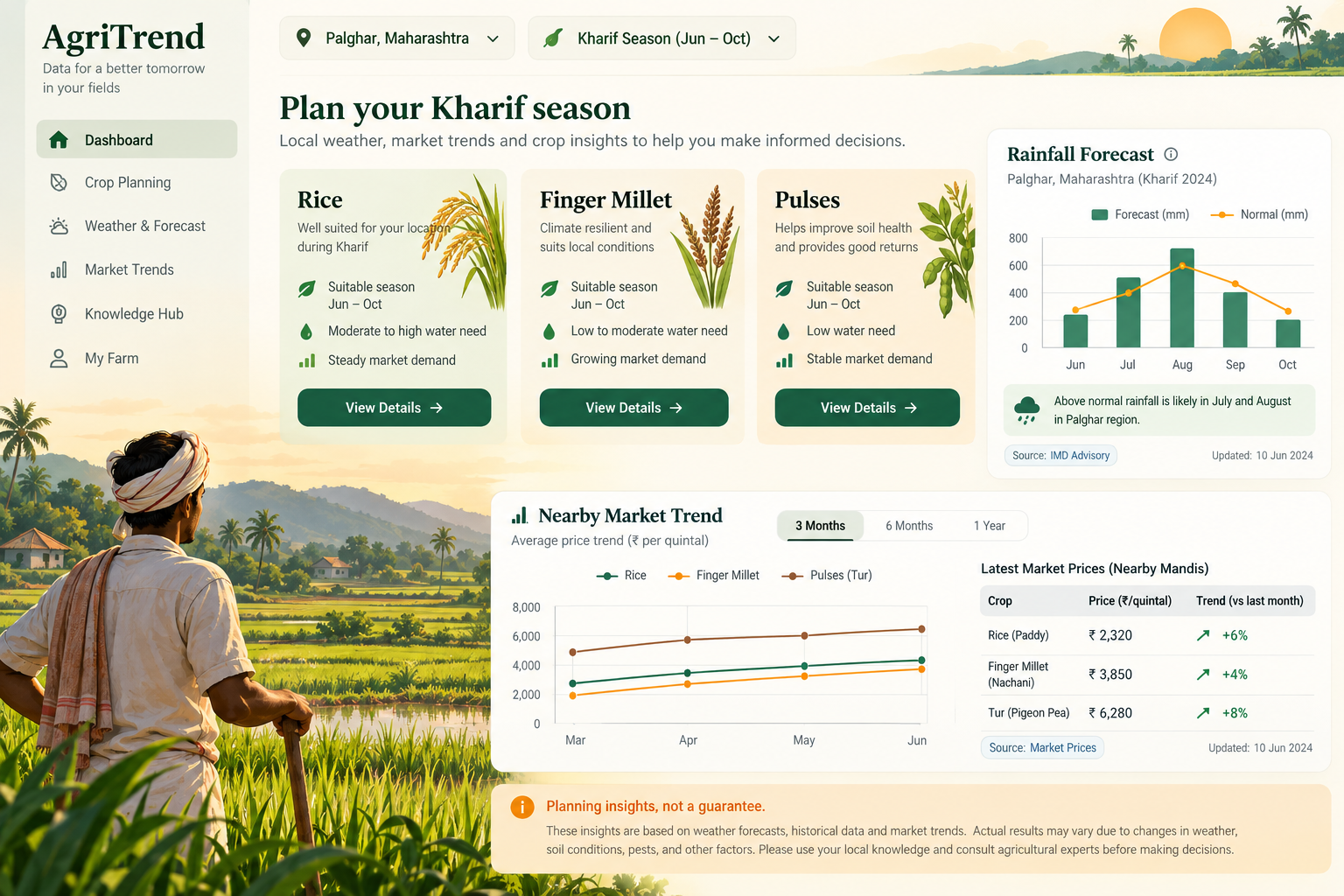
A farmer deciding what to plant is also making a decision about weather, soil, water, timing, cost, and the market they may sell into. AgriTrend is my idea for an e-market and agricultural intelligence platform that could bring these signals together, helping farmers explore their options before a season begins.
This is a proposed project concept, not a built product or a promise of higher income. It would support farmer judgement with useful information, while making uncertainty and data limits clear.
Why the decision is difficult
Crop planning often happens with incomplete or scattered information. A farmer may need to ask: Which crops suit my land and season? What do local forecasts suggest? How much water may be needed? What are nearby markets paying, and how have prices and arrivals been moving? What costs and risks should I consider before choosing?
These questions are connected. A crop may look attractive in a market report but be unsuitable for local soil or water conditions. A weather forecast can inform timing, but it cannot guarantee rainfall. A price seen today does not guarantee the price at harvest. A useful tool should help compare factors rather than give a single overconfident answer.
What AgriTrend could bring together
- Location and season: district or local area, planting window, and relevant agro-climatic context.
- Weather and climate: current forecasts, seasonal context, and official agricultural advisories where available.
- Farm conditions: soil information, water access, previous crops, and farmer-provided constraints.
- Market signals: historical and recent prices, arrivals, nearby market options, and demand indicators where reliable data exists.
- Decision support: side-by-side crop comparisons, estimated input considerations, risks, and links to trusted sources.
The platform could present several plausible crop options and explain why each appears in the comparison. Farmers should be able to review the assumptions, adjust their own details, and consult local agricultural experts before making a decision.
From information to a practical comparison
A possible workflow would begin with a farmer selecting a location, season, and crop interests. The platform could then show available weather advisories, relevant growing conditions, and market information for nearby mandis. A comparison might include water needs, typical growing duration, input considerations, recent price history, and the freshness and source of each data point.
Where reliable local data is missing, the system should say so. It should not invent a recommendation or treat a broad district average as if it describes every farm. Local language, low-bandwidth access, simple charts, and assisted use through farmer groups or extension workers could make the information more accessible.
Existing services and the proposed idea
Some building blocks already exist in India. The India Meteorological Department provides agricultural meteorology services, including weather forecasts and agrometeorological advisories intended to support farm decisions. e-NAM is a government electronic trading network connecting existing APMC mandis and provides farmers access to price information and wider market participation. These are existing services; AgriTrend is only my proposed concept for bringing selected weather, location, farm, and market signals into a farmer-friendly planning view. Any future version would need to verify data access, terms, quality, and partnerships instead of implying integration that does not yet exist.
What the platform must get right
A recommendation can influence a farmer’s livelihood, so the design must be careful. Data should show its source, date, coverage, and uncertainty. Crop suggestions should be guidance for comparison, never a guarantee. The platform should protect personal and farm data, avoid hidden sponsored rankings, and make it possible to correct inaccurate information. It should also be evaluated with farmers and agricultural experts in different regions before being trusted for real decisions.
Market data alone cannot solve structural issues such as transport, storage, credit, or bargaining power. A digital marketplace can make information easier to compare, but it should not claim to remove intermediaries or ensure better prices for every farmer.
Why I want to explore it
I am interested in how data and technology can help people make practical decisions. AgriTrend connects that interest with agriculture: instead of showing disconnected charts, it would try to answer the questions a farmer is already asking, in the context of their land, season, and nearby markets.
The next step would be discovery with farmers, agricultural educators, and local experts: understand how crop choices are made today, what information is trusted, and which decisions a simple first version could genuinely support.
Frequently asked questions
Is AgriTrend already available?
No. It is an early project idea, not a completed platform.
Will it tell farmers exactly what to plant?
The goal would be to compare options and explain supporting information, not dictate a crop or guarantee an outcome.
Can weather forecasts predict a successful harvest?
No. Forecasts and advisories can support planning, but weather remains uncertain and outcomes depend on many local factors.
How is this different from e-NAM?
e-NAM is an existing electronic trading platform connecting mandis. AgriTrend is a proposed planning concept that would combine selected farm, weather, and market information; it is not an e-NAM feature or partner.
What would need to happen before development?
Farmer interviews, expert review, data-source checks, privacy planning, and a small pilot to test whether the comparisons are understandable and useful.
SEO and sharing notes
Alternative titles: 1. AgriTrend: Using Weather and Market Data for Crop Planning; 2. Smart Agriculture in India: Connecting Farm Decisions to Data; 3. Could Agricultural Market Intelligence Help Farmers Plan Crops?
Meta description: Explore AgriTrend, a proposed platform combining local weather, farm conditions, and market signals to help Indian farmers compare crop-planning options.
Primary keyword: agricultural market intelligence. Related keywords: smart agriculture in India, digital farming, crop planning, weather-based farming, e-marketplace for farmers, data-driven agriculture, crop recommendation system, precision agriculture, farm market trends.
Suggested URL: /blog-farm-market.html. Related pages: Projects, Mini Smart Irrigation idea, and Blog.
Blog excerpt: AgriTrend is an early idea for helping farmers compare crop options using local growing conditions, weather advisories, and market signals. It would make information easier to review while keeping uncertainty visible and farmer judgement central.
LinkedIn introduction: What should a farmer plant this season—and what information would make that choice clearer? I’m exploring AgriTrend, an idea for connecting local weather, farm conditions, and market signals in one practical planning view. It is a concept, not a finished product, and I’m interested in what farmers and agricultural experts would need from a tool like this.
Illustration ideas: 1. A farmer comparing crop options on a phone with weather and market panels; 2. A simple flow diagram from location and season to crop comparison; 3. A map showing nearby markets alongside clearly dated price indicators.
← Back to all blog posts